
White Clover Trials Test Variety Difference

White Clover reliance is growing in Ireland. This is driven by farmers desire to improve sustainability, recent high chemical N pricing and clear messaging from policy on the need to reduce reliance on chemical N. There is a strong economic advantage of increased white clover on Irish farms.
Considering the lower contribution of white clover to sward in recent years, the rate of breeding gain in grasses has been much greater than in clovers. Pasture Innovations partner Teagasc has been bucking this trend with extensive development of new and improved white clover varieties that suit the Irish system.
Because Pasture Innovations primary focus is to breed for temperate grazing systems like Ireland, clover varieties are bred to tolerate frequent tight animal grazing. This is showing through in official trials. For example, the new white clover variety CLODAGH is showing higher clover density in trials after several years evaluation. This is a realisation of the breeding direction for clovers that can tolerate grazing pressure.
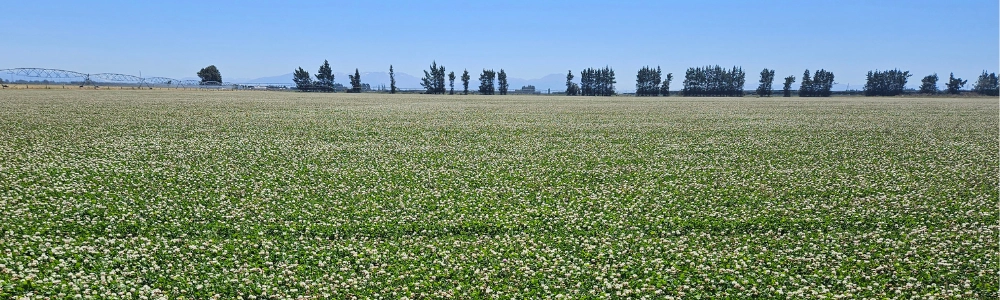
Clodagh under seed production in New Zealand in December 2024. CLODAGH commercial seed is expected to arrive in the coming Months.
DUNGLOE is another new variety from Pasture Innovations and will also have commercial seed arrive in the coming months
While final results from official trials are still pending release, preliminary results from official trials confirms the performance from these varieties will be a step change. When it comes to total yield, both DUNGLOE and CLODAGH are unmatched in total yield performance. Improved clover varieties builds farmer confidence to rely on white clover as a source of Nitrogen and quality feed for animals. Varieties that can yield more or have higher N fixation increase the potential contribution that white clover can realise for an individual farmer. Other additional traits include spring growth. Because white clover less active of the colder months of the year, more spring active varieties can more quickly meet the spring feed demand.
Nitrogen fixation and additional traits
To supplement the data coming from official trials, Teagasc established an extensive white clover trial at Teagasc Moorepark, Fermoy, Cork in 2022. The trial is being conducted by PhD candidate Ciara Carroll under the supervision of Research officer Dr. Tomas Tubritt. 17 clover varieties were sown, with each variety subjected to three different Nitrogen treatments. In 2023, varieties were aloud express their differences and to overcome the establishment effect. Different nitrogen rates will test how varieties perform under different levels of N. Varieties are replicated a number of times to get a true representation of each variety to ensure there is no advantage of disadvantage from different parts of the test area.
Difference already clear
Even though the trial is sown under two year ago, clear difference are already visually clear between varieties in test in April 2024. While it’s far too early to draw conclusive findings from this trial, a greater proportion of clover in plots now could be driven by greater establishment vigour, greater persistence and competition or better spring growth at this time. Clodagh is very clearly one of the varieties high clover proportions at this time and it will be interesting to see how both Cloagah and Dungloe do over the full term of the trial
For More information on this trial, see the video below:


